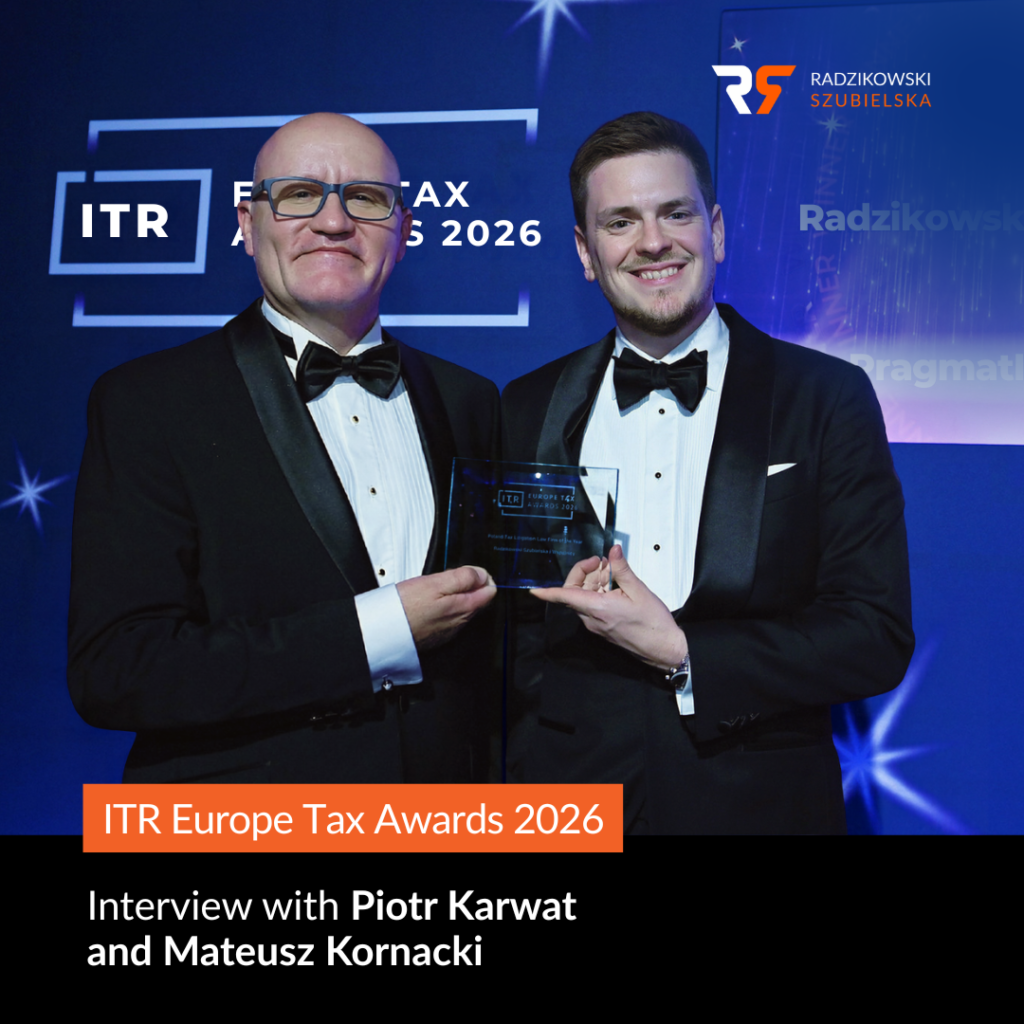
1. What are the ITR Europe Tax Awards, and how prestigious are they within the European tax community?
The ITR Europe Tax Awards are among the most prestigious accolades in the European tax market. The award for tax disputes is particularly meaningful to us because practices are assessed based on the actual cases they have handled, as well as their significance and outcomes. In tax disputes, success rarely comes down to a single well-drafted submission. More often, it is the result of a consistently executed strategy pursued over several years.
2. This success reflects the work of the entire team. What do you think sets RS Legal’s tax disputes practice apart?
What sets us apart is the combination of deep tax expertise and a strong track record in litigation. In tax disputes, simply being right does not determine the outcome – in fact, who is “right” often does not become clear until the very end. A thorough understanding of procedural rules, the ability to make effective use of the finer details of the evidence and a well-crafted strategy for the proceedings as a whole are equally important. Sometimes we win a case because we identify an argument that makes it unnecessary to address the substantive merits at all.
3. What does your day-to-day work within the team look like, and how do you work with clients?
We are an agile team that approaches every case we decide to take on with genuine enthusiasm. Although organisational considerations require one lawyer to take the lead on each matter, everyone on the team takes an interest in what their colleagues are working on. After all, we often find it difficult to decide which dispute is more interesting, our own or a colleague’s. This allows us to exchange ideas and develop the best possible strategy, which must always be approved by the client. Maintaining regular contact with the client enables us to respond quickly and collaboratively, adjusting the strategy whenever necessary. This approach earns us the trust of clients, who feel confident entrusting us with their most complex and high-value matters. We aim to compete not on the size of our team, but on the strength of our client relationships, our willingness to take on the toughest cases and the results we deliver.
4. What was the greatest challenge for the tax team over the past year? Which cases, projects or achievements are you most proud of – subject, of course, to client confidentiality?
The past year was extremely busy. We handled a number of complex WHT, VAT and CIT disputes in parallel, some involving very substantial amounts as well as international or EU law aspects.
The cases that give us the greatest satisfaction are those in which our strategy makes a tangible difference to the client, whether by bringing a long-running dispute to an end, recovering significant amounts or persuading the tax authority to change its position, ideally before the case even reaches court. We have recently brought several such cases to a successful conclusion.
5. What matters most to you when working with clients on tax disputes, which often involve several stages and require a long-term strategy?
Above all, thinking several moves ahead. In tax disputes, the costliest mistakes are often made long before a case reaches court – sometimes as early as the tax audit stage.
That is why, from the outset, we want to understand the client’s objective, identify the weaknesses in the case and assess the potential impact of individual decisions on the subsequent course of the proceedings. It is equally important to us that, with our support, the client fully understands all these issues. Honesty is also essential. Clients should be aware not only of the arguments available to them, but also of their limitations.
6. Have clients’ expectations of advisers handling tax disputes changed? If so, in what way?
Yes, very clearly. Clients increasingly expect more than another analysis concluding that “the matter is open to interpretation.” They want to know what to do about that uncertainty.
They expect clear recommendations: what their options are, what risks each option entails, how long the dispute may take and what its financial and business implications may be. Good counsel should be able to translate a complex tax issue into a specific business decision. They should also be prepared to participate in making that decision – not on the client’s behalf, but together with them. It is important to remember that clients deal with matters entirely unrelated to tax disputes in their day-to-day work. They expect their counsel to provide more than recommendations or legal advice; above all, they expect active involvement in managing the dispute.
7. What does winning the title of “Tax Litigation Law Firm of the Year – Poland” mean for the firm and the future development of its tax practice? What would you like to achieve in the near future?
For us, it confirms that the direction we have chosen is delivering results. We want to continue handling complex disputes of major importance to our clients involving VAT, CIT and WHT, particularly those with an EU or international law dimension. However, we do not shy away from disputes that may initially appear more straightforward but, in practice, can prove no less interesting than those concerning the major taxes mentioned above. Real estate tax is a prime example. For clients in several of the industries we advise, it has given rise to numerous highly complex, high-value cases.
A team’s ability to manage a tax dispute successfully depends only to a certain extent on the type of tax involved. What really makes the difference, and what our clients value most, are the strengths we have already mentioned. They are essential to performing at the highest level. Our ambition is to build one of the best tax teams in the market.
8. Finally, if you had to sum up in one sentence what this trophy means to you, what would you say?
The hope that every client we show it to will say, or at least think, “You simply deserved it.”